




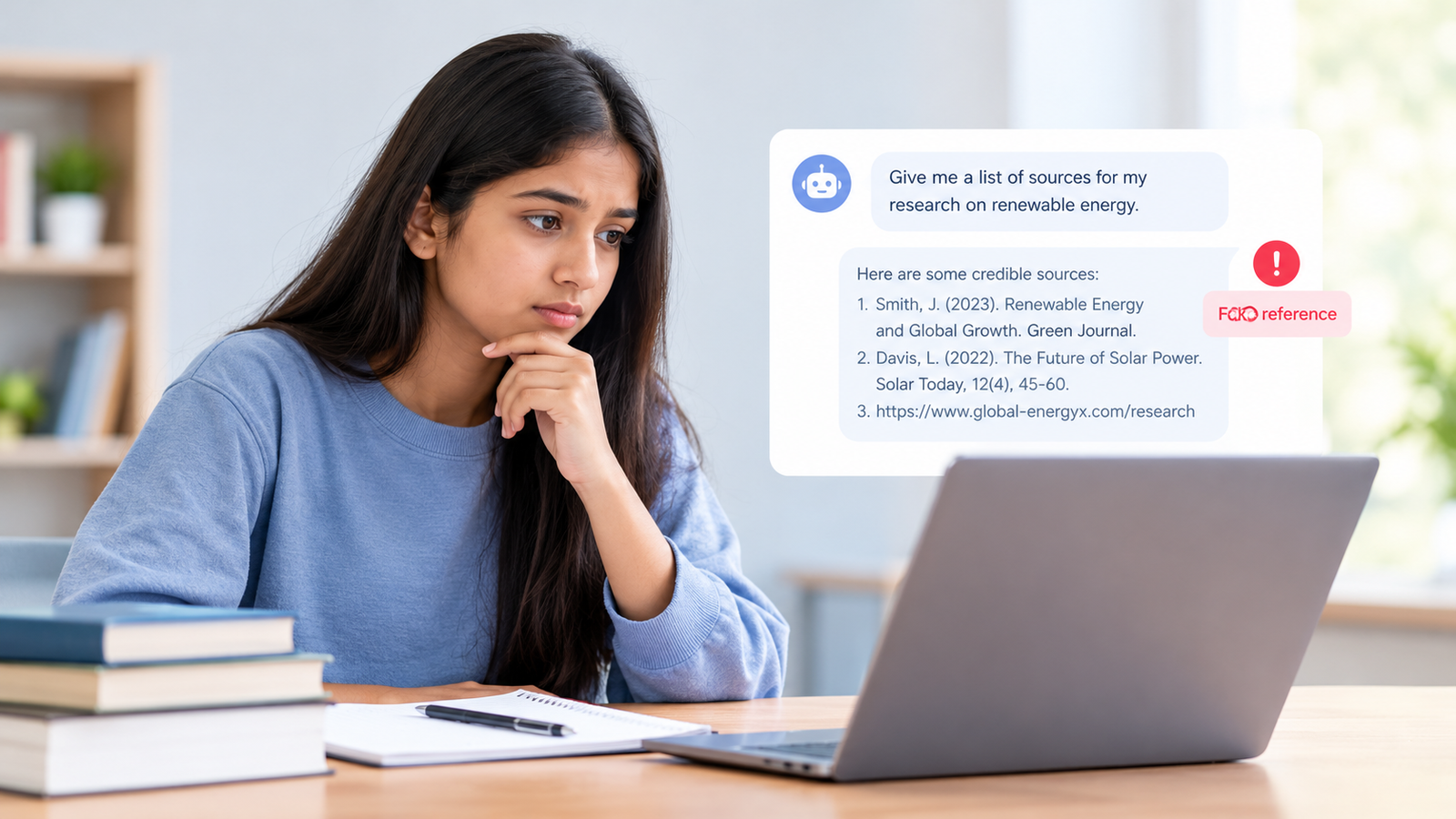
Students use AI tools to explain difficult topics, brainstorm essay ideas, and summarise long readings. Teachers use them to draft lesson plans, quizzes, and feedback. Researchers use them to scan literature and organise notes. Used well, these tools save time and make learning more accessible.
There is a catch. AI can produce answers that sound confident, well-written, and authoritative, and are still wrong. A smooth explanation is not a verified one.
This matters in education because learning depends on accurate information. A false date in a history essay, an invented source in a research paper, or a flawed formula in a lesson plan can spread quickly. Checking AI-generated information is now a core academic skill.
What Are AI Hallucinations?
An AI hallucination is an output that looks credible but is false, misleading, or made up. The AI is not lying, because it has no intent. It generates text that fits the pattern of a good answer, even when the facts behind it are missing.
In practice, hallucinations show up as:
- False facts: claims that sound plausible but are untrue.
- Incorrect dates and figures: wrong years, statistics, or measurements.
- Fabricated references: books, articles, and authors that do not exist.
Why Does AI Generate Incorrect Information?
Understanding the causes makes hallucinations easier to anticipate.
- Limits in training data. AI models learn from large collections of text. That text can contain errors, biases, and gaps, and the model may reproduce them.
- Missing or outdated information. A model may not know about recent events, new research, or updated curricula. It may still answer as if it does.
- Ambiguous questions and thin context. A vague prompt like “Explain the war” leaves the AI guessing which war, which period, and which level of detail. Guesses can drift into error.
- Plausible answers without evidence. Most language models predict likely next words. They are built to produce fluent text, not to check each claim against a trusted source. When the model lacks a reliable answer, it can still produce one that sounds right.
Common Types of AI Hallucinations in Education
Educational settings tend to produce a few recurring kinds of error:
- Incorrect facts, statistics, and history. Wrong dates, misattributed quotes, and invented statistics.
- Fake research papers, authors, and citations. Realistic-looking titles, journal names, and DOIs that lead nowhere.
- Incorrect scientific or mathematical explanations. Flawed reasoning in a physics problem, or a calculation with a hidden mistake.
- Misleading summaries. A summary of a chapter or article that omits key points or adds claims the original never made.
- Outdated information presented as current. Old guidelines, laws, or research findings described as the latest.
How AI Hallucinations Affect Students and Teachers
The effects reach everyone in the learning process.
Students may submit assignments containing false claims, lose marks, or face academic integrity questions over sources they never checked. Over time, some develop an overreliance on AI, accepting answers without asking whether they make sense.
Teachers may unknowingly build worksheets, quizzes, or lesson plans on inaccurate material, which then reaches a whole class.
Researchers can lose hours tracking down references that turn out to be fabricated.
Trust suffers too. When learners and educators run into repeated errors, they may lose confidence in digital learning tools, including the reliable ones.
How to catch these errors:
- Search the exact title in Google Scholar or your library database.
- Check that the journal, volume, and pages exist.
- Compare surprising claims with a textbook or a reputable encyclopedia.
- If a source cannot be found, treat it as unreliable and do not cite it.
How Students Can Verify AI-Generated Answers
Verification does not need to be complicated. A few habits go a long way:
- Check facts against trusted sources. Compare claims with textbooks, course materials, and established educational websites.
- Verify references. Look up citations in academic databases such as Google Scholar, JSTOR, or your institution’s library, and open the original publication when possible.
- Check dates and credentials. Is the source recent enough? Is the author qualified in the field?
- Cross-check important claims. If only one source says it, be cautious. Confirm with at least two independent ones.
- Ask for help. When something remains unclear, ask a teacher, librarian, or subject expert.
A useful rule: the more important the claim, the more carefully it should be checked.
How Teachers and Schools Can Prevent AI-Related Errors
Schools can reduce risk through clear systems, not just individual caution.
- Set guidelines for responsible AI use. Spell out when AI is allowed, how to disclose it, and what counts as misuse.
- Teach digital literacy and fact-checking. Make source evaluation a regular classroom skill, not a one-off lesson.
- Review AI-generated materials. Read lesson plans, quizzes, and answer keys before using them with students.
- Encourage independent research. Ask students to explain their reasoning and show the sources behind their work.
- Train educators. Give teachers practical training on how AI tools work, where they fail, and how to evaluate their output.
Some teachers ask students to find and correct an error in an AI-generated answer. It builds critical thinking and shows why verification matters.
Can Technology Reduce AI Hallucinations?
Yes, to a degree. One widely used approach is retrieval-augmented generation (RAG). In simple terms, instead of answering only from what it learned during training, the AI first retrieves relevant documents from a chosen collection and then writes its answer based on them. It works a bit like an open-book exam rather than a closed-book one.
Other helpful measures include:
- AI systems grounded in trusted educational sources, such as approved textbooks and curriculum materials.
- Citations and source links, so users can check where an answer came from.
- Human review, where a teacher or expert checks important content.
These methods lower the risk, but they do not remove it. An AI can still misread a source, summarize it poorly, or cite it incorrectly. Source links are only useful if someone actually opens them.
Best Practices for Using AI Responsibly in Education
- Treat AI as a learning assistant, not an authority. It can explain, suggest, and organize, but it should not have the final word.
- Verify important facts before using them in assignments, lessons, or research.
- Never cite a source without confirming it exists. Find it yourself first.
- Follow school and university AI policies. Rules differ between institutions and even between courses.
- Protect personal information. Avoid entering names, grades, contact details, or sensitive data into AI tools.
Conclusion
AI tools can make learning faster, more flexible, and more engaging, but they can also be confidently wrong. AI hallucinations in education are not a reason to avoid AI altogether. They are a reason to use it with care.
Human judgment, reliable sources, and a habit of asking “How do I know this is true?” remain the best protection. Students and teachers who build those habits can use AI as a genuine support for learning without being misled by it.
FAQs
1. What are AI hallucinations in education?
They are false or invented outputs from AI tools, such as wrong facts, incorrect explanations, or nonexistent references, that appear in learning, teaching, or research contexts and look believable.
2. Why does AI sometimes provide incorrect answers?
AI models generate likely-sounding text based on patterns in their training data. They can be limited by gaps or errors in that data, outdated knowledge, unclear questions, and the lack of a built-in way to verify every claim.
3. How can students check AI-generated information?
Compare claims with textbooks and trusted websites, look up citations in academic databases, check publication dates and author credentials, cross-check with independent sources, and ask a teacher when in doubt.
4. Can AI create fake research citations?
Yes. AI can produce references with realistic authors, titles, and journals that do not exist. Always confirm that a source is real before citing it.
5. Can AI hallucinations be completely eliminated?
Not at present. Techniques like retrieval-augmented generation, source citations, and human review reduce errors, but none guarantees accuracy, so verification remains necessary.